

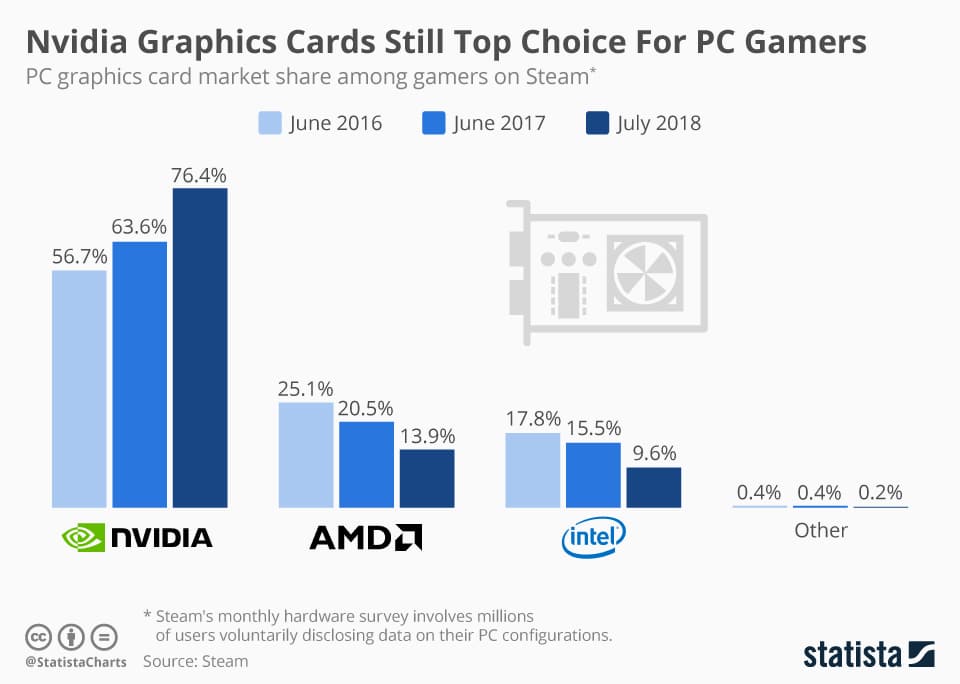
NVIDIA’s Dominance in Gaming
For years, NVIDIA has been one of the most recognizable names in PC gaming. Walk into almost any gaming forum, esports setup, or high-end gaming PC build, and there’s a strong chance you’ll see a GeForce RTX graphics card inside. While AMD produces competitive GPUs, many gamers consistently gravitate toward NVIDIA products.
But why?
Is it marketing? Performance? Features? Driver stability? The answer is a mix of technical advantages, ecosystem strength, and long-term brand positioning.
This article explores why many gamers prefer NVIDIA GPUs, what makes them attractive, and whether that preference is justified.
🚀 1. Strong Performance in High-End Gaming
One of the biggest reasons gamers prefer NVIDIA is simple: performance leadership, especially at the high end.
Historically, NVIDIA has:
-
Dominated the ultra-high-end GPU market
-
Delivered top-tier 4K gaming performance
-
Led in ray tracing capabilities
For gamers who want:
-
Maximum FPS
-
1440p high-refresh gaming
-
4K ultra settings
-
Ray tracing enabled
NVIDIA often offers some of the strongest options available.
Performance leadership builds reputation. When gamers associate a brand with “the fastest card,” it creates lasting preference.
✨ 2. Ray Tracing Advantage
Ray tracing is one of the biggest modern graphics advancements. It simulates realistic lighting, reflections, and shadows.
NVIDIA was first to mainstream real-time ray tracing in consumer GPUs and continues to optimize heavily for it.
Why this matters:
-
Many AAA games now include ray tracing
-
NVIDIA GPUs tend to handle ray tracing more efficiently
-
Frame rate drops are often less severe compared to competitors
For gamers who care about visual realism, this is a major selling point.
🧠 3. DLSS (Deep Learning Super Sampling)
DLSS is one of NVIDIA’s most influential technologies.
What DLSS does:
-
Uses AI to upscale lower-resolution images
-
Increases FPS significantly
-
Maintains strong image quality
For example:
-
Render at 1440p
-
Display at near-4K quality
-
Gain extra performance
DLSS allows gamers to:
-
Enable ray tracing while maintaining playable FPS
-
Extend the lifespan of their GPU
-
Improve performance without lowering settings drastically
This AI-based upscaling has become a major reason gamers choose NVIDIA.
🎥 4. Streaming & Content Creation Features
NVIDIA GPUs are widely favored by streamers.
Why?
Because of NVENC — NVIDIA’s hardware video encoder.
NVENC:
-
Offloads encoding from the CPU
-
Reduces performance impact while streaming
-
Produces consistent stream quality
This allows gamers to:
-
Game and stream on one PC
-
Maintain stable frame rates
-
Avoid expensive dual-PC setups
For creators and streamers, this feature alone can justify choosing NVIDIA.
🛠️ 5. Driver Stability & Day-One Game Support
NVIDIA has built a reputation for:
-
Frequent driver updates
-
Day-one game optimization
-
Strong compatibility with new releases
When major AAA games launch, NVIDIA often provides:
-
Optimized drivers immediately
-
Performance patches quickly
-
Feature integration support
While driver stability can vary by generation, the perception of reliability has helped build gamer trust.
🏆 6. Esports & Competitive Gaming Popularity
Look at competitive esports tournaments:
-
Most pro players use NVIDIA GPUs
-
Most gaming cafés and tournament rigs use GeForce cards
Why?
-
High refresh rate optimization
-
Strong performance at 1080p and 1440p
-
Stable driver ecosystem
Competitive players prioritize:
-
Low latency
-
Stable FPS
-
Smooth frame pacing
NVIDIA has marketed heavily toward the esports community, strengthening its dominance.
🖥️ 7. Ecosystem & Software Features
NVIDIA offers a large ecosystem beyond just hardware.
GeForce Experience
-
Easy driver updates
-
Game optimization suggestions
-
Built-in recording tools
NVIDIA Reflex
-
Reduces system latency
-
Useful for competitive shooters
Broadcast AI
-
AI noise removal
-
Virtual background
-
Webcam enhancements
These features create a broader “package” that appeals to gamers beyond raw FPS numbers.
🧬 8. Brand Recognition & Trust
Brand loyalty plays a role.
Many gamers:
-
Bought NVIDIA cards years ago
-
Had good experiences
-
Stick with what works
Reputation builds momentum. When a brand consistently delivers strong products, consumers default to it.
NVIDIA has maintained strong brand identity in gaming for decades.
💡 9. Strong High-End Focus
While AMD competes aggressively in mid-range markets, NVIDIA often pushes the limits at the very top.
For gamers who want:
-
“The best GPU available”
-
Maximum performance regardless of cost
NVIDIA frequently occupies that space.
High-end dominance influences brand perception across all tiers.
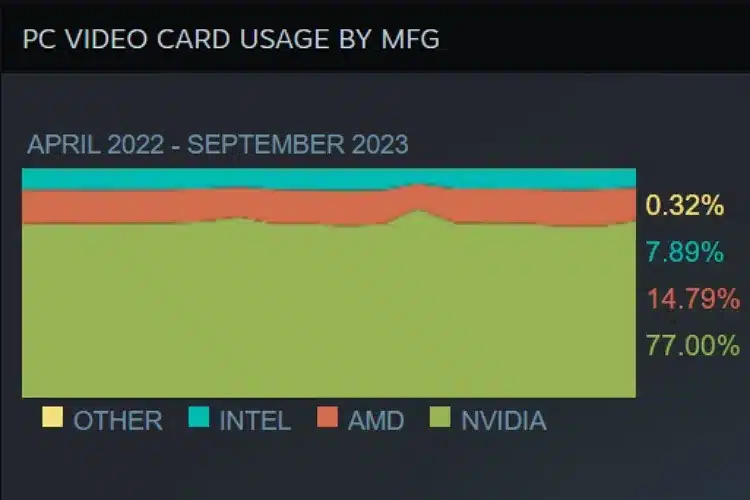
📈 10. Market Share Momentum
When more gamers use NVIDIA:
-
Developers optimize more for NVIDIA
-
Game engines prioritize NVIDIA features
-
Communities share NVIDIA-focused settings
This creates a cycle:
More users → more optimization → more users
That network effect strengthens preference over time.
⚖️ Is NVIDIA Always Better?
Not necessarily.
While NVIDIA has strong advantages in:
-
Ray tracing
-
DLSS
-
Streaming encoders
-
High-end dominance
AMD often competes strongly in:
-
Price-to-performance
-
Raw rasterization performance
-
VRAM capacity in certain tiers
Preference doesn’t always mean objectively superior in every category.
🎯 Why Many Gamers Still Choose NVIDIA
When you combine:
-
Strong ray tracing
-
DLSS performance boosts
-
Streaming features
-
Esports presence
-
Reliable driver support
-
Brand recognition
It becomes clear why many gamers feel safer choosing NVIDIA.
Even if AMD offers competitive alternatives, NVIDIA’s ecosystem often feels more complete to many users.
🔮 The Future of GPU Preference
The gaming GPU landscape continues evolving.
As technologies like:
-
AI upscaling
-
Frame generation
-
Ray reconstruction
-
AV1 encoding
…become more important, feature ecosystems matter as much as raw performance.
Gamers increasingly choose not just a graphics card, but a software platform.